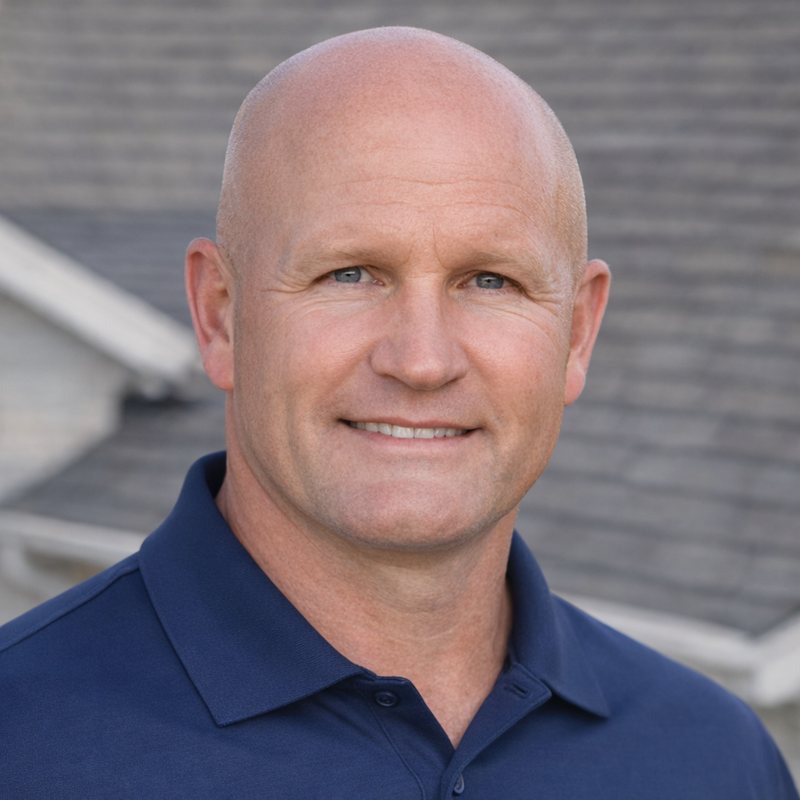
Jarod Wallace · Owner, Alpine Roofing Specialists
27+ years roofing Utah · 10,000+ roofs installed · Licensed & insured (UT contractor #369642-5501)
Every year after a big wind or hail event, Utah homeowners sign roofing contracts with companies they met that same week — sometimes that same afternoon. Most of those jobs turn out fine. Some don't. And the difference almost never comes down to price, or even the estimate itself. It comes down to the company behind the signature. After 27 years and more than 10,000 roofs across Utah, I can tell you that five questions — asked before you sign anything — will tell you more about a roofing contractor than any sales presentation ever will. None of them are rude. All of them are fair. And how a contractor reacts to being asked is often the most useful answer you'll get.
Can I verify your license and insurance right now?
Not "are you licensed and insured?" — every contractor says yes to that. The question is whether you can verify it, today, before you sign. In Utah, every legitimate roofing contractor holds a license registered with the Division of Professional Licensing (DOPL), and you can look it up online in about two minutes. The lookup shows whether the license is active, whether it's the right classification for roofing work, and whether there's any disciplinary history.
Then ask for a current certificate of insurance — both general liability and workers' compensation — issued directly to you, not a photocopy from a folder. This matters more than most homeowners realize: if a crew member is injured on your property and the contractor's coverage isn't what they claimed, the exposure can land on you as the homeowner.
A contractor with nothing to hide will give you the license number before you finish asking. Ours is printed right at the top of this article and on every bid we write: UT contractor #369642-5501. Look it up. That's what the number is for.
| What to verify | How | Green light | Red flag |
|---|---|---|---|
| Contractor license | Utah DOPL online lookup | Active, roofing classification, no discipline | "It's under my partner's name" |
| General liability insurance | Certificate issued to you | Current, matches the business name on your contract | Expired, or a different company name |
| Workers' compensation | Certificate issued to you | Covers everyone who'll be on your roof | "Our guys are all independent" |
A few minutes of verification before signing beats years of regret after. Every item above is free to check.
What a good answer sounds like: "Here's our license number — pull it up on DOPL right now, and I'll have our insurance agent send you current certificates today."
How long have you operated under this exact name, in this area?
Notice the precision: this exact name, this area. A company can truthfully say "we've been in roofing for 20 years" while the actual business entity on your contract was registered eight months ago, under its third name, with a mailing address two states away. The company name on the contract is the one that owns your warranty — not the salesperson's résumé.
There's a rhythm to this in Utah. A storm rolls through, and within days, crews and sales reps appear from everywhere — knocking doors, offering free inspections, and moving fast because they need signatures before the season ends. Some are legitimate. But when the work is done and the trucks move on to the next storm market, the warranty on your contract is only as good as the entity that signed it — and whether that entity still exists, still answers the phone, and still operates here in year five.
To be fair: every good company was new once, and a newer local company can do excellent work. The point isn't age — it's verifiability. Ask where the physical office is. Ask for addresses of roofs they installed in your city three or more years ago — not last month — so you can drive past the track record. Ours is in Lindon, and we've served Utah under the same name since 1999.
What a good answer sounds like: "Same name, same office — here are roofs we did in your neighborhood five years ago. Drive past any of them."
Who will actually be on my roof, and who's accountable for their work?
The person who sells you the roof is almost never the person who installs it. That's normal — but you should know who is installing it. Some companies run their own crews. Others work with long-term installation partners they've used for years. Excellent roofs get built under both models. What separates good companies from risky ones is accountability: Who supervises the crew? Who performs quality control? Who do you call if something looks wrong on day two — and will that person actually show up?
Ask three specific things: Will the crew installing my roof be your employees or subcontractors? Who is the on-site supervisor, by name? And who inspects the finished work before you're asked for final payment? Vague answers here — "we've got great guys" — usually mean the contractor doesn't fully know who'll be on your roof either, because the labor gets sourced job by job. That's how corners get cut without anyone deciding to cut them.
What a good answer sounds like: "Here's the name of your crew lead, and here's who walks the roof before we ever ask for final payment."
What does your workmanship warranty cover, in writing — and who honors it in year five?
There are two warranties on every roof, and homeowners routinely confuse them. The manufacturer's warranty covers the shingles as a product — often 30 to 50 years. The workmanship warranty covers the installation — the flashing details, the nailing, the ventilation work. Here's the uncomfortable truth: most roof leaks in the first ten years trace back to installation, not product failure. Which means the warranty that protects you most is the one from the contractor — and it's only worth something if the contractor is still around to honor it.
Two follow-ups tell you most of what you need to know. First: get the workmanship warranty in writing, as part of the contract — what it covers, what voids it, how long it lasts, and whether it transfers if you sell the house. Second: ask whether the contractor is certified by the shingle manufacturer they're quoting. The strongest manufacturer warranty tiers are only available through installers the manufacturer has certified — so certification isn't a plaque on the wall, it directly changes which warranty you're eligible for.
Then connect it back to question 02: a 10-year workmanship warranty from a company operating under a name registered last spring is a 10-year promise from a company with a 10-month history. The paper is identical. The protection is not.
What a good answer sounds like: "Our workmanship warranty is printed in the contract — here's what voids it — and we're certified with the manufacturer, which qualifies you for their upgraded warranty."
How do payments, surprises, and problems get handled?
This is the question that protects your money, and almost nobody asks it before signing. Four things belong in writing before work starts.
The payment schedule. An established roofing company has supplier accounts and working capital — it doesn't need most of your money before a single shingle arrives. Ask how payments are staged, and be cautious of any structure that's heavily front-loaded before materials are on site.
The price of surprises. The most common surprise on a re-roof is decking damage that only becomes visible after tear-off. Ask for the per-sheet replacement price in the contract, before work starts — and ask how change orders are handled: documented and signed, or verbal. "As needed" with no unit price is how a $17,000 roof becomes a $21,000 roof three weeks in.
Lien waivers. Here's one most homeowners have never heard of: if a contractor doesn't pay his suppliers or subcontractors, those unpaid parties can, under certain conditions, place a lien against your home — even if you paid the contractor in full. Ask whether the company provides lien waivers as payments are made and at final payment. A contractor who pays his people has no problem with this question. A contractor who hesitates just told you something important.
Warranty service. If you have an issue in year three, what's the actual process — who do you call, and what's the response time? Then ask the question almost nobody asks: Can you tell me about a job where something went wrong, and how you fixed it? Every roofer has glowing references. The revealing reference is the job that went sideways — because how a company behaves when it costs them money is the truest thing you'll ever learn about it.
What a good answer sounds like: "Payments are staged with the work, the decking price is in the contract per sheet, and here's exactly how a warranty call gets handled."
The bottom line
None of these five questions require any roofing knowledge. They require about twenty minutes, a DOPL lookup, and the willingness to ask a salesperson to slow down. A contractor worth signing with won't just tolerate these questions — they'll respect you for asking, because the companies these questions filter out are the same ones giving good roofers a bad name.
Your roof is a 20-to-25-year decision attached to the biggest asset you own. The company matters as much as the shingles. Ask the five questions. Verify the answers. Then compare the bids — and when you do, our guide on how to compare roofing estimates in Utah picks up exactly where this one leaves off.
If you'd rather start with a contractor who welcomes all five of these questions, license posted, owner on the phone, request a free roof inspection. Every Alpine bid starts with our 7-Point Roof Assessment. We serve Orem, Provo, Lehi, American Fork, and every city in Utah. Same name, same number, since 1999.
Ready to get a straight answer on your roof?
Call directly or book a free, no-pressure inspection. We'll give you honest options — repair, replace, or wait.